Self Assessment
Limited Company Tax Calculator added!
Over on our sister site Employed and Self Employed, we now have a Limited Company Tax Calculator. If you are self employed through a limited company (as many people, like IT contractors, can be), then your tax is worked out differently from if you are just plain-old self employed. The limited company pays you a salary, which is typically quite small, and the rest of the company’s profits are paid to you in dividends (after the company has paid corporation tax), which are taxed at different rates from other income. The following graph shows you a comparison of how much income you get to take home as self employed or with a limited company (click on the image for a larger version).
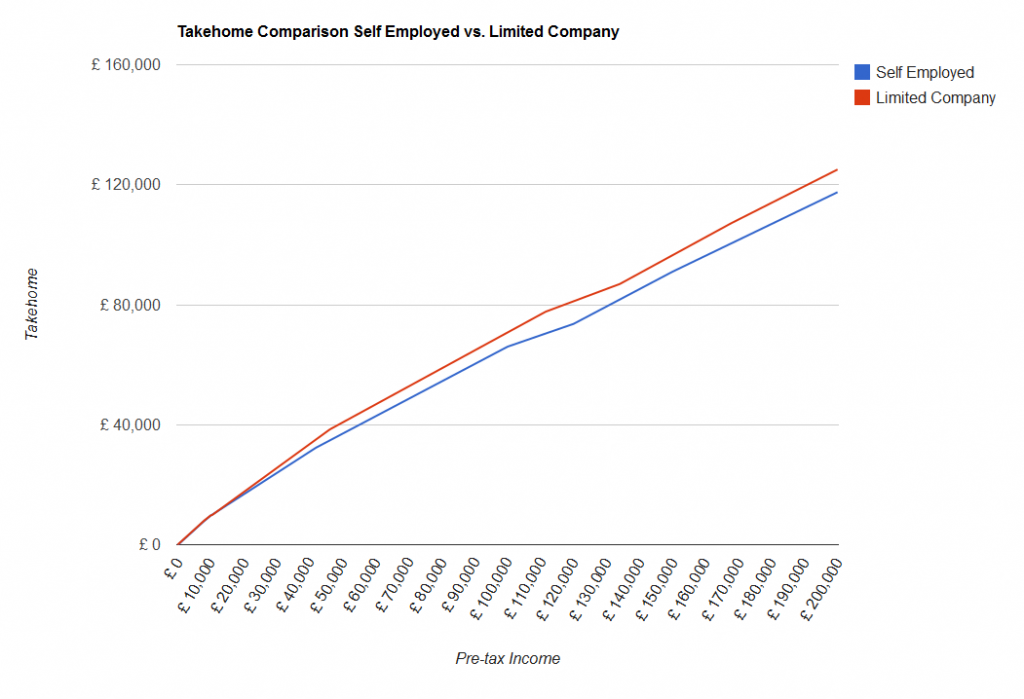
Click the image for a larger, interactive version
As you can see, in this example (with typical values entered), the limited company approach allows you to take home more of your income. However, this does come at a cost – more paperwork is required for limited companies, including registering with Companies House and having your books prepared by an accountant. Accountant’s fees might eat up a significant amount of the difference in take-home, so it might not be worth switching from one to another. If you’re interested in being self employed as a limited company, speak to an accountant to find out if it is right for you.
To start performing tax calculations, check out the limited company tax calculator over at Employed and Self Employed.
None of the content on this website, including blog posts, comments, or responses to user comments, is offered as financial advice. Figures used are for illustrative purposes only.
Changes to Child Benefit
As you might have seen in the news, the government has introduced changes to who is eligible to receive Child Benefit, taking effect from 7th January 2013. If you or your partner earn over £50,000, the amount of Child Benefit you are eligible for will be reduced – and if one of you earns over £60,000 you will not be eligible to receive any Child Benefit. Those who are earning between £50,000 and £60,000 will have a choice to make before 7th January, since they can still keep some of the Child Benefit they are used to. You can either:
- Opt out of Child Benefit, and stop receiving it from 7th January 2012
- Choose to continue receiving Child Benefit, but pay a “High Income Charge” as an extra tax, effectively reducing their net Child Benefit. To do this, they must register for Self Assessment and complete a tax return each year
If you choose option 2, you will receive the same amount of Child Benefit as you currently do – but you will have to complete a tax return at the end of the tax year, and HMRC will levy an additional tax of some (or all) of the Child Benefit you received. This so-called “High Income Charge” is calculated as a proportion of where your total income comes between the £50,000 and £60,000 thresholds – e.g., if your income is £55,000, you will have to pay back 50% of the Child Benefit you receive. The income used is your “adjusted net income”, which is not simply your salary – you must add to this any additional income like interest paid on savings, and deduct eligible pension contributions. When you complete a tax return through Self Assessment, HMRC will work out your adjusted net income and the proportion of Child Benefit that you must repay. The High Income Charge will never be more than the Child Benefit you or your partner received. More information is available on HMRC’s High Income Child Benefit Charge page.
If you find yourself in the £50,000 – £60,000 income band, you have a limited amount of time to decide whether you are going to give up Child Benefit or register for Self Assessment (if you haven’t already) and pay the High Income Charge. To help you understand better how this will affect you, there is a government tool you can use to help decide what to do, which will guide you through the relevant points to consider.
Categories
Tags
-
50% tax
2022
April 2010
April 2011
April 2012
budget
coronavirus
cost of living
cost of living crisis
covid-19
debt
dollar
economics
Economy
election
Employed and Self Employed
Foreign Currency
foreign exchange rates
HMRC
holiday
holiday money
house prices
houses
income tax
interest rates
Jobs
Loans
Mortgages
national insurance
Pay As You Earn
pension
Pensions
personal allowance
pound
recession
recovery
savings
Self Assessment
self employed
self employment
student loans
tax rates
The Salary Calculator
unemployment
VAT
Sponsored Links
Archive
- February 2026
- January 2026
- December 2025
- November 2025
- October 2025
- September 2025
- August 2025
- July 2025
- June 2025
- May 2025
- April 2025
- March 2025
- November 2023
- September 2023
- August 2023
- July 2023
- June 2023
- May 2023
- April 2023
- March 2023
- February 2023
- January 2023
- December 2022
- November 2022
- October 2022
- September 2022
- August 2022
- July 2022
- June 2022
- May 2022
- April 2022
- March 2022
- February 2022
- January 2022
- December 2021
- November 2021
- October 2021
- September 2021
- August 2021
- July 2021
- June 2021
- May 2021
- April 2021
- February 2021
- January 2021
- December 2020
- November 2020
- October 2020
- September 2020
- August 2020
- July 2020
- June 2020
- May 2020
- April 2020
- March 2020
- February 2020
- November 2019
- September 2019
- April 2019
- March 2019
- December 2018
- April 2018
- March 2018
- January 2018
- May 2017
- March 2017
- February 2017
- September 2016
- June 2016
- March 2016
- February 2016
- January 2016
- June 2015
- April 2015
- March 2015
- February 2015
- January 2015
- November 2014
- October 2014
- July 2014
- June 2014
- May 2014
- March 2014
- February 2014
- January 2014
- November 2013
- October 2013
- August 2013
- July 2013
- June 2013
- May 2013
- April 2013
- March 2013
- February 2013
- January 2013
- December 2012
- November 2012
- October 2012
- September 2012
- August 2012
- July 2012
- June 2012
- May 2012
- April 2012
- March 2012
- February 2012
- January 2012
- December 2011
- October 2011
- May 2011
- April 2011
- March 2011
- January 2011
- December 2010
- August 2010
- July 2010
- June 2010
- May 2010
- April 2010
- March 2010
- February 2010
- January 2010
- December 2009
- November 2009
- October 2009
- September 2009
- August 2009
- July 2009
- June 2009